
Inflation data, trading activity of foreign investors and global trends would dictate sentiment in the stock market this week, according to analysts.

US President Donald Trump announced on Friday that he has cancelled a previously expected second wave of military attacks on Venezuela, following his military action in Caracas which led to the capture of the South American country's leader Nicolas Maduro and his wife, citing improved cooperation from Caracas and the release of a large number of political prisoners as part of efforts to 'seek peace'.
Iranian President Masoud Pezeshkian maintained a stance of defensive necessity, noting that Tehran is "forced to retaliate to attacks" but clarified that this does not imply a dispute with neighbouring countries

'The next two to three weeks will not be decided in Washington.' 'They will be decided in Tehran, in whatever calculation Iran makes about the costs of continued resistance against the costs of appearing to have yielded.'
The depreciation of Indian rupee against the US dollar is expected to push the country's import bill by about $15 billion, think tank GTRI said on Thursday. Compared to December last year, the Indian Rupee (INR) has depreciated 2.34 per cent against the US dollar, moving from Rs 83.25 to Rs 85.20, while the Chinese Yuan has weakened by 0.06 per cent, the Global Trade Research Initiative (GTRI) said.
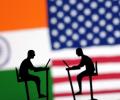
The US said India will lower tariffs on a "vast array" of American industrial and agricultural goods, such as "fruits, vegetables", to zero per cent under the trade deal announced by President Donald Trump.

Oil producers cartel OPEC's share in India's oil imports fell to an all-time low of 46 per cent in April as purchases of cheaper Russian oil peaked, industry data showed. Organization of the Petroleum Exporting Countries (OPEC) nations, mainly in the Middle East and Africa, had a 72 per cent share of all crude oil India imported in April 2022. This share slid to 46 per cent in April 2023, according to energy cargo tracker Vortexa.
Oil accounts for about a third of India's total imports and higher dollar prices combined with a rupee near all-time lows have increased its cost.

India's import of cheap Russian oil scaled another record in May and is now more than the combined oil bought from Saudi Arabia, Iraq, UAE and the US, industry data showed. India took 1.96 million barrels a day from Russia in May, 15 per cent more than the previous high in April, according to data from energy cargo tracker Vortexa. Russia now makes up for nearly 42 per cent of all crude oil India imported in May.

rediffGURU Dr Shyam Jamalabad tells you how to take care of your gums and teeth.

India's handling of the Iran crisis reflects a growing strain between strategic autonomy and geopolitical alignment, observes Ambassador M K Bhadrakumar.
Several farmer organisations in India are protesting the proposed India-US trade deal, expressing concerns about its impact on the agriculture sector and demanding the resignation of the Commerce Minister.

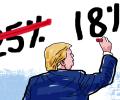
Democratic Senator Jeanne Shaheen's comments came amid a major downturn between New Delhi and Washington after US President Donald Trump doubled tariffs on Indian goods to a whopping 50 percent, including a 25 percent additional duties for India's purchase of Russian crude oil.

The turning point came with the appointment of Sergio Gor as the US ambassador to India.

Former Indian envoys to Venezuela R Viswanathan and Yashvardhan Kumar Sinha said the action was anticipated and even 'unsurprising' in nature, claiming that the US has always worked against Maduro's regime.
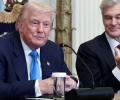
US President Donald Trump announced a deal with Pakistan to develop its oil reserves, suggesting Pakistan might sell oil to India in the future.

India and the European Union (EU) on Tuesday announced the conclusion and finalisation of negotiations for the proposed free trade agreement (FTA).

Gautam Gambhir says individual milestones don't matter and urges focus on trophies after India's T20 World Cup triumph over New Zealand.

'Based on the joint statement, a formal agreement will be drafted, which may take a month or month-and-a-half to finalise. We aim to sign the formal agreement by mid-March.'

The question is no longer whether the war will expand. It has. The next few days will tell us whether the war stabilises around Hormuz or whether the Strait itself becomes the trigger for a far larger rupture. What to watch for over the next 48 hours is simple: Any move by the US toward direct naval control of the Strait; any credible Iranian attempt to disrupt or mine shipping lanes and, critically, whether energy infrastructure in the Gulf continues to be targeted.If those lines are crossed in tandem, the war will no longer be containable within the region.
'Whatever is necessary for life and is not made in your country, we will import it from outside.'
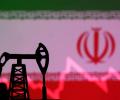
The United States has imposed sanctions on at least half a dozen Indian companies accused of trading in Iranian petroleum and petrochemicals as part of broader action targeting 20 entities worldwide.
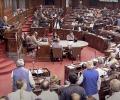
Opposition MPs in the Rajya Sabha criticised the Modi government's economic policies, citing the LPG crisis, lack of energy security, and concerns over the Economic Stabilisation Fund.
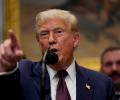
On Friday, during the weekly media briefing, MEA spokesperson Randhir Jaiswal, when asked about media reports that some Indian oil companies have stopped taking oil from Russia, had said India has made clear its approach on the issue.
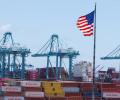
Indian exports to the US will face a 10% tariff, down from 25%, for 150 days following a US Supreme Court ruling. However, uncertainty persists due to potential further tariff hikes and long-term implications.

Modi also said that President Trump's leadership is vital for global peace, stability, and prosperity.

'We were in a heavily nuclearised environment. China had tested for Pakistan in the 1980s and helped their missile programme stay just one step behind us.'

'There are times when India should stand up without hesitation and voice its indignation over the US' pressure tactic. This is one such moment,' asserts Ambassador M K Bhadrakumar.

Commerce and Industry Minister Piyush Goyal announced that an interim trade agreement between India and the US is likely to be signed in March and operationalised in April, with chief negotiators meeting in Washington to finalize the details.

Amid the political push and pull, the Centre's decision to allow sugar exports and remove the 50 per cent duty on molasses exports has rekindled hope in the industry that more relief may follow.

Indian restaurants are grappling with a severe LPG shortage due to the West Asia conflict, forcing them to innovate with menus and cooking methods or face potential closures, impacting the food industry and consumers across the country.

A new study reveals that green hydrogen's potential as a sustainable fuel is contingent on the rapid decarbonisation of energy grids worldwide.

'The contours of the trade deal need to be reworked now.'

A senior Russian diplomat has called the US pressure on India for its procurement of Russian crude oil "unjustified," expressing confidence in continued energy cooperation between India and Russia despite external pressures.

'The US is strongly placed to expand its crude supplies to India.'

'In my experience of politics, I have seen political grips and political chokes are mostly hidden. The average person cannot see them,' Rahul Gandhi said.

If the Iranian regime needs to be punished for promoting quasi-terrorist outfits like Hezbollah and Hamas, then what about Pakistan which has spent decades exporting terror around the world, killing thousands, particularly in Afghanistan and India? asks M R Narayan Swamy.

What we are watching is something different: A fog manufactured and maintained by the people who started the war, so that the question of why it was started never has to be answered, observes Prem Panicker in his must read blog on the war in the Middle East.

The US government, under President Trump, justifies the intervention as a security necessity rather than a resource grab. The primary official reasons include: narco-terrorism charges, national security and migration crisis.
